
In the machining field one of the important factors is linked to production performance.
An increasingly competitive world, where the combination of quality and low cost is taken for granted, forces machining workshops to improve their performance with large investments both in terms of systems and in terms of highly specialized staff.
When the pieces to be obtained are made of stainless steel, the challenge is even more difficult: stainless steels have characteristics that are difficult to reconcile with machining:
- Strong tendency towards strain hardening.
- Very low thermal conductivity (especially in the case of austenitic stainless steels) which prevents the workpiece from dispersing heat optimally, contributing to overheating the tool.
- High coefficient of thermal expansion which causes the workpiece to force the tool.
- Difficulty in breaking the chip.
- Formation of the built-up edge.
Available in the following
profiles and dimensions:
ROUND
HEXAGON
To improve the machinability of stainless steels, grades containing significant percentages of sulfur have been created which allow greater chip breaking, such as AISI 303, AISI 430F, AISI 416. Sulfur forms, in combination with manganese of the particular non-metallic inclusions, manganese sulphides, which have the characteristic of making the steel more fragile and consequently also the chip that forms during machining.
Even in the case of non-resulphurised steels such as 304 and 316, a small percentage of sulfur is added (0.020-0.030) which still allows to obtain a better chip breaking.
But all this is often not enough: in addition to breaking the chips, reducing the consumption of the inserts is essential to reduce machine downtime and the related costs for replacing the plates themselves.
For this reason, since the 80s of the last century, a particular processing of stainless steels has been developed which has allowed the creation of complex non-metallic inclusions which have the characteristic of improving chip breaking and reducing the negative impact of non-metallic inclusions of hard metals (silicates and aluminates) present within the stainless steel which have a negative impact on the cutting edge life of the inserts.
The first steelworks in the world to have used this processing technique to produce stainless steels with improved machinability was Avesta (Sweden), a company which later merged with British Steel Stainless Steel, forming Avesta Sheffield which, in 2001, merged with the Finnish steelworks Outokumpu, which has been acquired in 2023 by Marcegaglia Stainless Sheffield.
Over the years, Marcegaglia Stainless Sheffield has increasingly refined the processing of these steels with improved machinability up to the present day, with the creation of the family of stainless steels called the Prodec®, which represent the answer to all machine tool machinability problems.
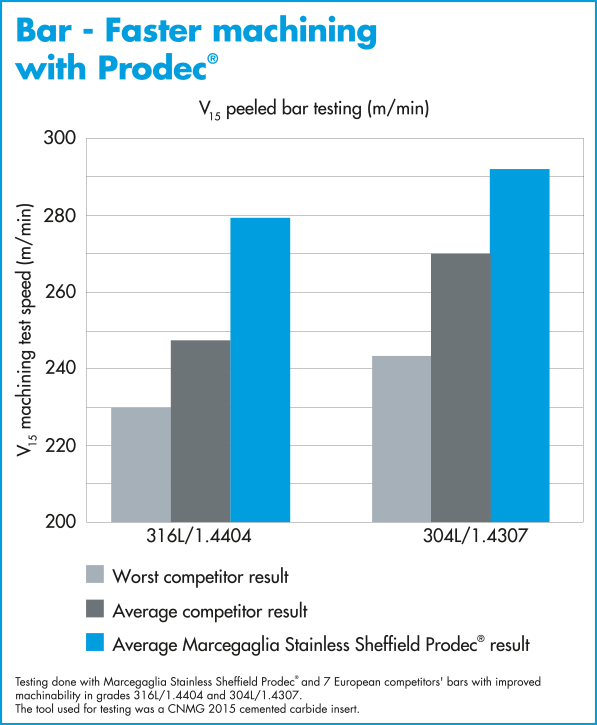
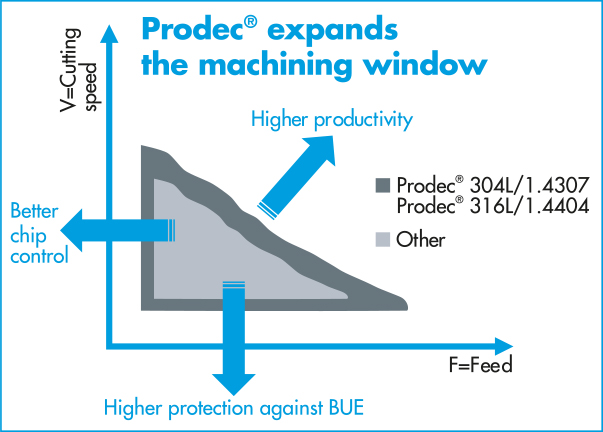
As can be seen from the graphs below, the Prodec® series steels have better performance than their competitors in terms of cutting speeds and inserts consumption, all with better results in terms of surface finish.
Choosing the Prodec® steels means reducing your costs and having an European product with constant quality over time.